
Dark Stars: the Observatory and the space telescopes
Coming in the next update (after Alpha 0.9.1: not in the game you can download yet; like all of space, it opens after the main story).
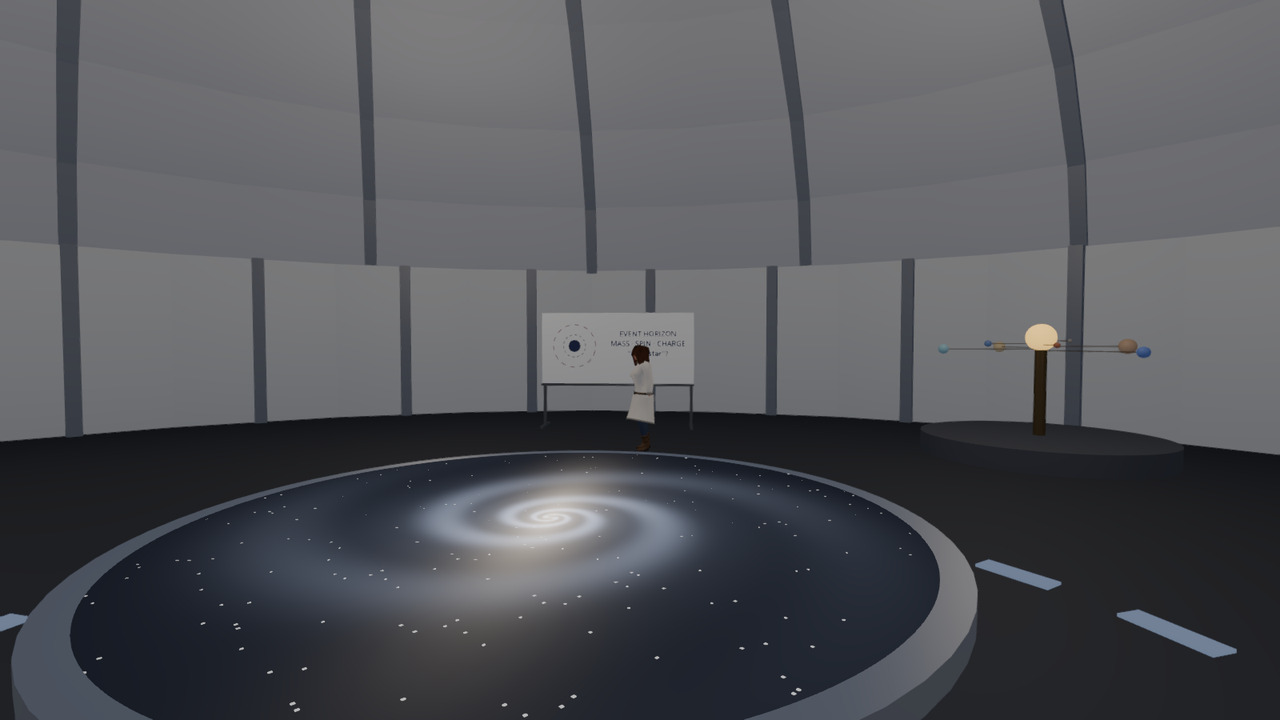
Behind the Observatory door on First Step's Concourse,  Dr Becky, an astrophysicist
who studies the black holes in the middle of galaxies, has five space telescopes and wants every one of them working. Her quest line,
Dark Stars, teaches what we really know about black holes, galaxies and the dark matter between them, one telescope job at a
time, from space level 200 to 500.
How it plays
- Each quest is one real piece of astrophysics, told as it is: what a black hole is (not a hole: a "dark star"), how stars die, the black hole at our galaxy's heart, quasars, galaxies killed by their own black hole, the little red dots, how big a black hole can grow, dark matter and the black hole's shadow.
- You fly to a telescope and upgrade it with parts you make, or point one at something, and see it in the telescope's feed (real Hubble, Webb, Event Horizon Telescope and ESO pictures for the famous ones, credited).
- Then you place it on your Galaxy Map yourself, from its direction and distance.
- Dr Becky's questions in the window are the mistakes people really make; a wrong pick is explained and you try again.
- Every step pays 2,500 Adventure XP; every quest Adventure XP and gold. Titles on the way: Stargazer, Observer, Astrophysicist, Cartographer of the Milky Way and, at the very end, Wormhole Hunter.
The quests
| # | Quest | Where | Level |
|---|---|---|---|
| 1 | Mountains of Matter | First Step's Observatory; the Lantern Eye in Earth orbit | 200 |
| 2 | Born in a Supernova | The Lantern Eye; the Observatory | 205 |
| 3 | The Heart of the Galaxy | The Coldwatch at Sun-Earth L2 | 215 |
| 4 | Brighter Than a Galaxy | The Lantern Eye; the Observatory's spectroscope | 225 |
| 5 | The Burp | The Quiet Array on the Moon's far side | 235 |
| 6 | Left Alone | The Trojan Deep at Jupiter's L4; the Observatory | 260 |
| 7 | Feeding Without a Merger | The Trojan Deep; the Quiet Array | 280 |
| 8 | Too Big, Too Soon | The Coldwatch | 300 |
| 9 | The Little Red Dots | The Coldwatch's spectrograph | 320 |
| 10 | How Big Can They Grow? | The Trojan Deep; the Lantern Eye's X-ray barrel | 350 |
| 11 | The Missing Middle | The Long Baseline at 110 AU; the Lantern Eye | 400 |
| 12 | The Wind You Cannot See | The Trojan Deep's lensing survey; the Quiet Array; the Long Baseline | 440 |
| 13 | The Shadow | All five telescopes | 480 |
| 14 | The Throat | The whole array; just past the Firewall | 500 |
The five telescopes
Each starts as a wreck or an empty pad and goes up five tiers. Every captain has their own tiers, their own feeds and their own map. The upgrade is done at the telescope, with the parts in your hold.
| Telescope | Where | Reached | Why there |
|---|---|---|---|
| The Lantern Eye like Hubble and Chandra | Earth orbit, in the Lantern Ring by First Step | in your craft | Above the air there is no twinkling, and the ultraviolet and X-rays the air soaks up get through. Close enough to service, like Hubble. |
| The Coldwatch like the James Webb Space Telescope | Sun-Earth L2, 1.5 million km out from Earth on the side away from the Sun | in your craft | At L2 the Sun, the Earth and the Moon all sit on one side, so one sunshield keeps the mirror in shadow and cold. Infrared is heat: a warm telescope would glow in its own pictures. |
| The Quiet Array like FARSIDE and LuSEE-Night | The Moon's far side, on the floor of Von Kármán crater | on foot | The Moon is turned the same face to Earth for ever, so its far side never sees Earth: 3,500 km of rock between the array and every radio on Earth. The quietest radio sky near us. |
| The Trojan Deep like Euclid and the Rubin Observatory | Jupiter's leading Trojan point, L4, 60 degrees ahead of Jupiter | in your craft | Out past the asteroid belt the zodiacal dust thins: sunlight scattered by dust is the glow that brightens the sky near us. Out here the sky is the darkest in the system (New Horizons measured it). |
| The Long Baseline like New Horizons' parallax and space radio links | 110 AU from the Sun, just inside the Firewall, square to the galaxy's centre | in your craft | A star's parallax is how much it shifts when you look from two places. From Earth the baseline is 2 AU; from here it is 110. Square to the galaxy's centre it measures the distances that build the map, and it is the far end of the widest radio link we can make. |
The parts
Made from the space metals at the usual furnace, anvil, workbench and clockwork bench.
| Part | What it is | Made with |
|---|---|---|
 Gyroscope set | Six spinning gyroscopes in a sealed case: they tell a space telescope which way it points (Hubble has six). |  Clockwork 85 |
 Radio antenna | A cobalt-alloy dipole on a copper feed: one of the array's many small antennas. |  Smithing 85 |
 Mirror segment | A segment of ultra-flat glass, palladium-coated: a telescope mirror is only as good as its smoothest part. |  Glassworking 87 |
 Sunshield layer | A sheet of spun silk, thinner than a hair, with a platinum film: five of them keep an infrared telescope in shadow. |  Crafting 89 |
 Detector array | A grid of light-sensitive pixels on a ruthenium-platinum readout: it counts every photon that lands (the CCDs astronomers made are in every phone now). | Clockwork 91 |
 Gold infrared segment | A rhodium-backed segment coated in gold, which reflects infrared better than anything (Webb's mirrors are gold). | Glassworking 93 |
 X-ray mirror shell | A barrel-shaped iridium-coated shell: X-rays only bounce off a mirror at a grazing angle (Chandra's mirrors are iridium-coated). |  Casting 97 |
 Maser clock | A hydrogen maser in an osmiridium cavity: a clock that loses a second in millions of years, so far-apart dishes can be combined. | Clockwork 99 |
 Cryocooler | A tetrataenite-magnet compressor that chills a detector to seven degrees above absolute zero (Webb's mid-infrared camera needs it). | Clockwork 99 |
 Starmetal optical bench | The frame everything else hangs on, cast in meteoric starmetal: the stiffest there is, so nothing moves a hair's width. | Casting 99 |
The Galaxy Map
- The Milky Way from above: the bar, the arms and the Sun on its small spur. It starts dark; each telescope's light reveals what it can see (visible light only a few thousand light years through the dust, infrared to the centre, radio across the whole disc).
- The Deep Sky: the other galaxies on a distance scale. Seen, studied and charted: not reachable yet.
- 34 things to find and chart (13 in our own galaxy). Once seen, the map draws its line of sight and its distance; click where they meet to chart it.